What Did She Groom Me For
by trc450
2DCG
Anal Sex
Big Tits
Creampie
Female Domination
Female Protagonist
Futa/Trans
Groping
Handjob
Harem
Lactation
Lesbian
Loli
Male Protagonist
Multiple Protagonist
Oral Sex
Romance
Sci-Fi
Sex Toys
Shota
Titfuck
Twins
Vaginal Sex
Your sister has groomed and doted on you until now. She suddenly left you in charge of landlording/landladying an apartment complex. - Minor changes based on your gender choice.
Screenshots
1.0
12/12/2025
v0.68
11/11/2025
v0.34
N/A
v0.33
Initial Release
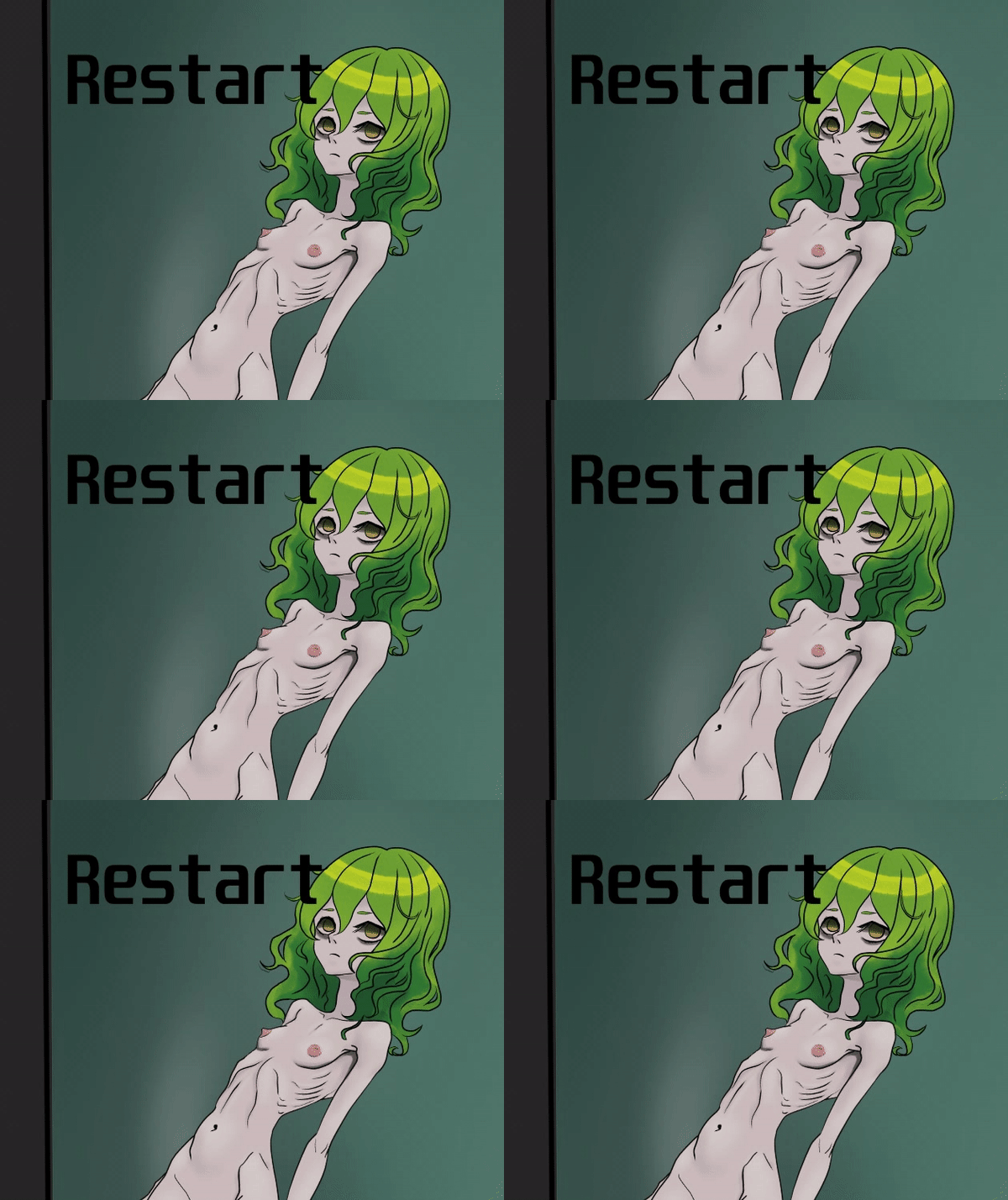
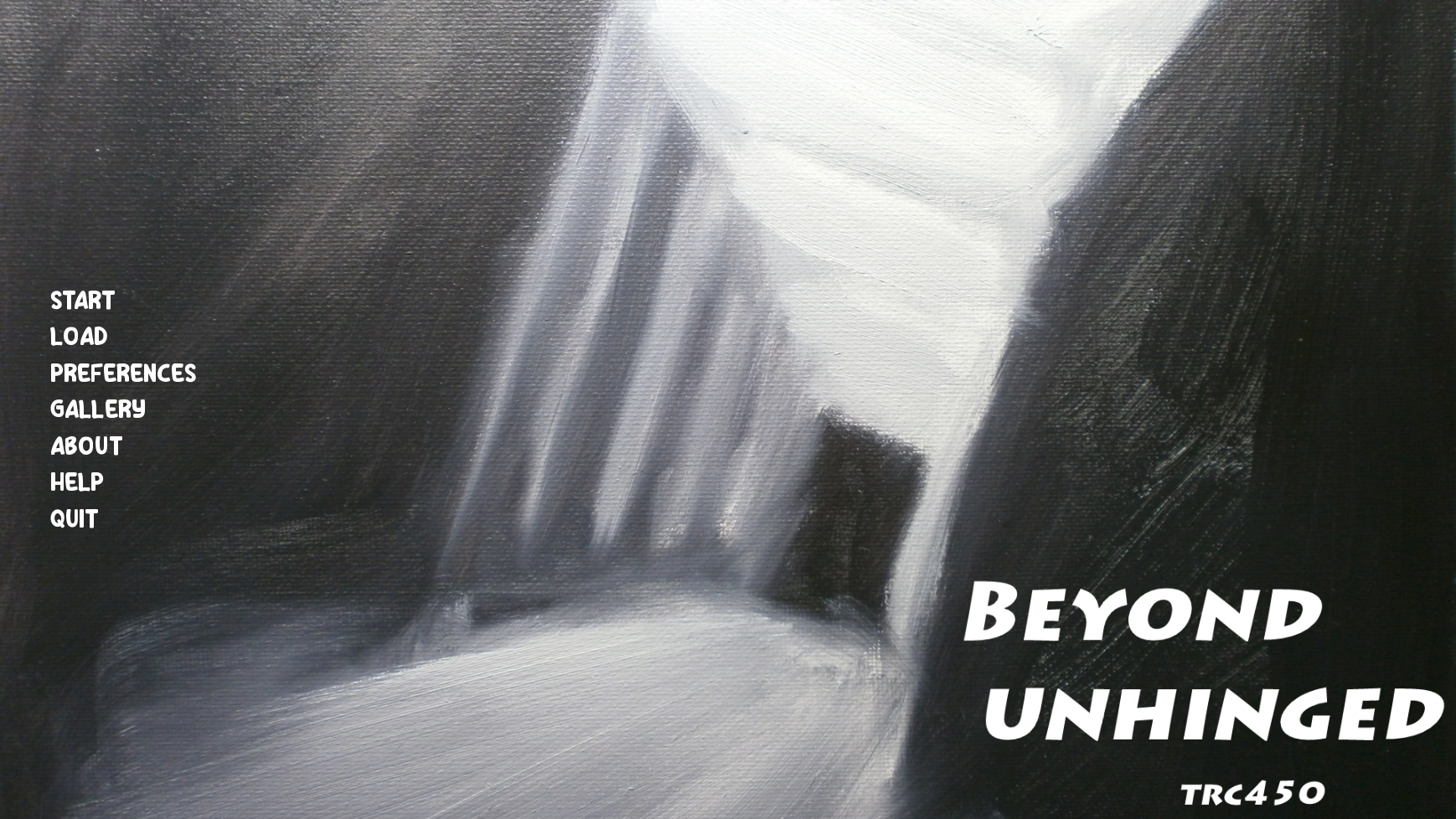
I won't bother to use proper structure, paragraphs and use of different adjectives for reviewing for this crap. This is perhaps the laziest AI slop on the entire forum. No renders, awful script, incomprehensible plot. Dev made a custom-made UX, but it inflates the game's worth worse than Venezuela's economy; it's literally the same sprites from the game in front of a grey background. If Dev bothered to make it, then why didn't they, for instance, made other renders for the gameplay? There's no renders for the hallway, there's no renders for whatever packages MC had to deliver... They went ahead as to make the main menu look different, but every single render is black. What you see on the banner with the green-eyed redhead is an actual render . Don't waste your precious time with this. Don't wait for further updates. No nothing. Avoid giving them any further attention.
If you spend any amount of time working with LLMs, it’s pretty obvious that the entirety of this game’s writing has been (quite poorly) generated via LLM. This is a very lengthy review. If you just want my conclusion, here it is: don’t waste your time . The game’s writing is atrocious . It rarely makes any amount of sense. There’s only a small handful of images—which surprisingly don’t appear to be AI-produced—that are… well, they’re not bad , per se, but they’re certainly not worth the awful slog that you have to go through to read this VN. You’d waste most of your time trying to make sense of what the fuck is going on, only to be rewarded with a small handful of mediocre H-CGs. It’s possible that the author used the LLM purely for translation (e.g., that the author is a non-English-speaker and used an LLM to translate a story they wrote in their language into English), although judging from the specific types of AI slop I’ve observed throughout What Did She Groom Me For’s writing, this is relatively improbable. I think it’s much more likely that the author is, perhaps , a non-native English speaker, and they used an LLM-assisted workflow, wherein they wrote down rather basic datapoints about the story (“backstory”) and then used an LLM (and a rather low quality one, at that) to create most —if not all —of the in-game text. Below, I’ll break down precisely why I believe this to be the case, by going through just the first nine lines from What Did She Groom Me For’s “prologue” (the introductory text) and pointing out precisely which so-called “AI Slop” exists in each line. I’d have done this for more lines, but… my god , there’s so much slop in this VN that even just this much took me ages . It’s abundantly clear that the author made next to no attempt at editing the LLM’s output—rather, they simply copy-pasted large chunks of it into the game’s script willy-nilly, and they did so, seemingly, without any rhyme or reason given to its placement. One last thing before I get started. The writing gets increasingly more nonsensical when the game actually properly starts. Most of it makes so little sense that it’s near impossible to understand what the fuck the story of What Did She Groom Me For is even supposed to be about . Perhaps this is a result of the author hand-writing more of the text than I believe, or perhaps this is the result of poorly cutting parts of the LLM’s output into the story—but, honestly… I’m not going to even try to guess what happened. Examining the introductory text should be more than enough to determine whether you want to bother with this story or not. Line 1 ¹(As the words ‘²(Time of play is over)’ left her lips), ³(a mixture of pride and detachment) ⁴(flickered in my sister’s eyes) . Click to expand... ‣ AI Slop Patterns ‣ 1. Lips Fixation The Pattern: “the words ‘…’ left (his/her/{name}’s) lips” An alternative: “the words—‘…’—left (his/her/{name}’s) lips” This pattern has numerous variations: “the words ‘…’ escaped (his/her/{name}’s) lips” “the words ‘…’ tumbled from (his/her/{name}’s) mouth” “the words ‘…’ past (his/her/{name}’s) lips” et cetera. Why It’s Slop: LLMs have a high probability of describing dialogue through their mechanics , despite the fact that it’s unnecessary, jarring, and often annoying for the reader. This type of writing is commonly referred to as “Purple Prose”—excessively poetic text—but in this case, it ends up making the text sound mechanical and awkward instead of poetic. Human writers focus on how something is said— whispered , shouted , stammered , sneered , and so on. LLMs— especially the older models or those with small parameter counts—often focus on the mechanics of the act of speaking. This behavior is likely due to statistical closeness of the concepts. ‣ 2. Uncanny Formalism The Pattern: “Time of play is over” Note: I believe it’s highly likely that this particular phrase was written by the author and not by the LLM. Judging by the prose found throughout What Did She Groom Me For , whatever LLM it is that the author used doesn’t appear to struggle too much with producing relatively natural-sounding language. It seems unlikely that it would produce bizarre text like “Time of play is over.” What they obviously wanted here was “Playtime is over” or something like it, but it would seem that the English language is not the author’s strong suit. The overall pattern this is included in ( As the words ‘Time of play is over’ left her lips, … ) is an extremely common LLM response; see the section immediately preceding this for a breakdown of that slop pattern. You’ll often see this kind of prose generated when a user message contains text like “Time of play is over,” she said. , t o which the LLM might then reply with something along the lines of As the words—‘Time of play is over’—left her lips, … at the very start of the LLM’s reply. Effectively, instead of generating a flowing, natural, and continual narrative, the LLM—having been trained on back-and-forth communication—instead directly references what was said in the previous turn. This is, quite obviously, extraordinarily obnoxious. Why It’s Slop: Smaller LLMs (e.g. 3B parameter models and smaller) can struggle to produce natural, idiomatic contractions and casual speech patterns. This results in robotic dialogue that reads like a script from an anime or old Japanese video game that has been poorly translated into English; à la the infamous English translation of Zero Wing with its “Somebody set up us the bomb” and “All your base are belong to us.” Any human writing this line—or at least, any human who was relatively fluent in English—would have written Playtime is over , not Time of play is over . Specifically, the phrasing of “time of play” is structurally awkward—not to mention overly formal for an interaction between two siblings—and indicates that the writer has extreme difficulty with writing dialogue with a natural rhythm. ‣ 3. “Mixtures” The Pattern: “a mixture of … and …” In truth, this pattern is much more wide-reaching: “a (mixture/blend/cocktail/etc.) of (emotion) and (emotion) .” Why It’s Slop: This is one of the most pervasive and obnoxious AI slop subtypes. LLMs produce text following this pattern excessively , making it one of the easiest methods of identifying LLM-written text. Simply look for “a mixture of X and Y,” and if you find numerous instances, you’re almost certainly looking at LLM-written text. This doesn’t necessarily mean the actual story itself was written entirely (or even in part) by an LLM—it could always be the case that the author used an LLM to translate into English. O f course, there isn’t anything inherently wrong with using an LLM to assist with writing. Where the use of an LLM in writing narrative text does go wrong, however, is in cases like What Did She Groom Me For , where the resulting story is so blatantly LLM-written—and makes so little sense—that the usage of the LLM becomes an aggravating factor for the reader. LLMs have many uses, and will continue to be used in creative endeavors, regardless of how you or I feel about it; we can only hope to educate creators on how to use AI models responsibly and intelligently as tools , rather than attempting to rely on them for the creation of their entire (or majority of) project. The concepts of “pride” and “detachment” are extremely difficult to visualize at the same time in one single expression. Think about it: how in the world would you use your face—or, hell, even your entire body—to express both pride and detachment at the same time? The LLM simply mashed together two opposing concepts, which ultimately created a sense of (entirely artificial) nuance within the text—nuance which immediately crumbles under any amount of scrutiny. ‣ 4. “Flicker” The Pattern: “flickered in (his/her/{name}’s) eyes” Alternatives: “flickered,” “danced,” “flashed,” “swam,” et cetera. Why It’s Slop: When LLMs write, they always come off as obsessed with eyes , breathing , and voices . In this case, we’re talking about the eyes , and LLMs rarely allow an expression to simply be shown to the reader. No, that would make too much sense, and would allow the reader to draw their own conclusions—and we can’t have that! Instead, LLMs almost always end up telling the reader precisely what that expression is supposed to emotionally “mean,” and they typically do so immediately after the expression is described. “Flickered” is simply the most statistically dominant verb for transient eye movements when it comes to LLM-generated prose. This prose is a common sensory cliché. The LLM can’t actually see the scene—let alone imagine it, as a human writer would—and it ultimately ends up relying on a limited set of movement verbs that are associated with eyes. The end result is this obnoxiously melodramatic tone, where every single goddamned glance becomes a literal light show of constantly shifting emotions that rarely have anything to do with the plot. Advice: If your model’s tokenizer treats it as a singular token, ban (as tokens, not strings) flicker and all of its alternatives. Note the space at the start—most tokenizers include a space at the start of each token that is a complete word (or the start of a word). If your software allows for it, ban the strings (not the tokens; these are all two or more tokens in length): flickered , flickering , flickers , and so on. Do so for all other garbage verbs that consist of two or more tokens. Continue on to ban the strings her eyes , his eyes , ’s eyes , 's eyes , my eyes , your eyes , their eyes . Also, ban: {character name}’s eyes and {character name}'s eyes for every character you’re writing about—e.g., John’s eyes and John's eyes . Do the same for gaze , breath , their variations, and any other physical aspect which your LLM model tries to constantly describe. Note that some tokenizers (such as Mistral’s, for example) tokenize “flicker” as the tokens f , lick , and er , so you may not even be able to ban flicker as a singular token, depending on which model you’re using. ‣ Line 2 ¹(She handed me the papers with a firm grip), ²(her fingers brushing against mine briefly) ³(before letting go). Click to expand... This one appears , on the surface, to be relatively normal writing—especially when compared to most of the other writing in this game—but it, too, contains several tells that give away the use of an LLM. ‣ AI Slop Patterns ‣ 1. Kinetic Dissonance / “Firm Grip” The Pattern: “ (He/She/{name}) handed (him/her/{name}) the (object) with a firm grip” In truth, this pattern is simply “ (pronoun) (verb) with a firm grip” or any instance of describing an action as being done with a “firm grip.” Why It’s Slop: LLMs have an irritating obsession with describing hands (much like eyes , breath , lips , and voices ), and frequently love to describe them as having a “firm grip.” Another common AI slop phrase that is in this same realm is “white knuckles,” seen in prose such as “Her fingers brushed against his as she held the papers with a firm grip, her knuckles turning white.” The LLM is essentially attempting to convey the sister’s personality—which was likely written as being authoritative or serious—through physical action, but it ultimately fucks up when it comes down to basic physics. To understand exactly why this is slop, try to visualize the scene. Imagine that you are handing someone else a few papers. How would you hold those papers, exactly? Loosely , right? If you had a “firm grip” on the papers, whoever you were handing them to would ultimately be caught in a game of tug-of-war over a stack of fucking papers . This slop prioritizes the statistical probability of the act of “holding” something with “a firm grip,” ignoring the fact that nobody would hand someone a stack of papers (expecting them to then take the papers) while gripping those papers “firmly.” This results in a ridiculous physical contradiction—one which a human writer would practically never find themselves writing. ‣ 2. Mandatory Micro-Touch The Pattern: “ (his/her/{name}’s) fingers brushing against (his/hers/{name}’s) briefly” This pattern is one which is difficult to define as a strict textual pattern, but rather exists as a concept found primarily within LLM-generated romance stories: character A hands something to B, and their hands must always “accidentally” touch—and in such a way in which their hands or fingers will always be described as “brushing.” Why It’s Slop: In fanfiction and romance novels, it is statistically probable for characters to brush hands “accidentally” when passing an object between them. The LLM ends up compulsively including these moments regardless of whether they’re relevant or whether they make any sense whatsoever in context. This slop attempts to force intimacy into the scene—and ultimately fails at doing so. In the real world—and in good writing—people frequently pass things to each other without their hands constantly coming into contact. In an LLM’s prose, though, transferring an object from one character to another is almost always used as a pretext for “fingers brushing”—at least in the context of romance stories. What’s more, the word “briefly” is also an incredibly common modifier used by LLMs in these sorts of situations—similar to “linger,” which LLMs also adore using unnecessarily—which acts as a form of “temperature regulation” within the scene. ‣ 3. The “Play-by-Play” The Pattern: “before letting go” This slop involves the act of describing linear time and physical mechanics with unnecessary precision: describe the physical action → explicitly state the cessation of the physical action. Why It’s Slop: When you read “She handed me the papers,” you already understand that “she” let go of the papers—if she hadn’t let go of them, she wouldn’t have handed them, she would be handing or be holding them out to then be retrieved. T he “before letting go” is entirely redundant and doesn’t need to exist within this prose. It serves no meaningful narrative purpose and acts only as a means of inflating the word count by narrating the obvious physical mechanics of the transaction. ‣ Line 3 ¹(In that moment), I could ²(feel the ³(weight of responsibility shift onto my shoulders), as if an unseen burden had been passed down to me). Click to expand... ‣ AI Slop Patterns ‣ 1. Temporal Crutch The Pattern: “In that moment” Common variations include: “at those words” and “for a split second.” Why It’s Slop: LLMs seem to have an almost desperate need to anchor abstract thoughts, concepts, and ideas to specific points in linear time. The “Temporal Crutch” is, plain and simple, unnecessary padding. The context of receiving the papers already establishes when the feeling of responsibility occurs. Human writers typically trust readers to follow the chronology without issue. LLMs, though, frequently like to explicitly mark transitions. ‣ 2. Tautological Simile The Pattern: “feel the …, as if …” Metaphorical statement → simile clause starting with “as if” that explains the metaphor using synonyms of the exact same words Why It’s Slop: The “Tautological Simile” is one of the most reliable identifiers of LLM writing in the era of GPT-3.5/GPT-4, and is particularly obnoxious. It effectively creates a pointless logical loop, which adds no additional information and has no reason to exist: “weight of responsibility” = “unseen burden” “shift onto my shoulders” = “passed down to me” A human writer would see this as redundant, and would be more likely to write something like, “I felt the hefty weight of the responsibility settling onto my shoulders.” The LLM, though, is trained to elaborate—to “make clear”—and so, it essentially ends up writing, “I felt heavy because of the responsibility, as if something heavy was given to me.” Advice: Even the “human-written” version of this statement that I presented above is by no means excellent writing—or even good writing, if we’re to be critical. It isn’t AI slop, but that doesn’t inherently make it attractive prose, either. When writing stories, authors should be focused strongly on the principles of “Show, Don’t Tell”—outright stating that your character feels weight on their shoulders because of the sense of responsibility is telling , not showing . Instead, demonstrate to the reader that the character feels stressed or burdened through the character’s actions , not by simply telling the reader as much. It comes off as lazy and boring when you simply tell the reader what a character feels. Avoid doing this at all costs. ‣ 3. Idiomatic Autopilot The Pattern: “weight of responsibility shift onto my shoulders” Why It’s Slop: If you feed an LLM the token “responsibility” in a narrative context, the LLM will invariably gravitate towards “shoulders”—it’s the most statistically probable body part to be associated with the specific abstract noun of “responsibility.” This phrase lacks any specific character voice. It’s like a stock photo, but in writing—a universally recognized, safe, cliché image that conveys the basic idea without any unique stylistic flair. It’s functional, but entirely soulless. This is also very much an instance of telling versus showing , as mentioned before. It’s far better to show the character experiencing the effects of the “weight of responsibility,” rather than explicitly stating that they exist. ‣ Intermission: Examination of Pacing After examining just these first three lines of text, we can see a huge tell in the pacing of the writing: Line 1: Words leave lips ( action ) → eyes flicker ( reaction ). Line 2: Papers handed over ( action ) → fingers brush ( reaction ). Line 3: Explicit statement of time (implied receipt) ( action ) → weight on shoulders ( reaction ). LLMs frequently fall into patterned prose that is repetitive and annoying, and that is precisely what we’re seeing here. ‣ Line 4 ¹(Her gaze lingered on me ²(for a second longer than necessary), a ³(silent acknowledgement) of ⁴(the bond we shared).) Click to expand... ‣ AI Slop Patterns ‣ 1. Interpretive Appositive The Pattern: The entire sentence is the pattern: “(some showing action), a (literal statement telling precisely what the action emotionally ‘means’).” This is otherwise known as the “‘Show, Then Tell’ Statement”; in other words, where you effectively ignore one of the most core rules of storytelling: “Show, Don’t Tell.” Why It’s Slop: This slop pattern is one of the most pervasive LLM missteps you’ll come across, and it’s immediately noticeable to anyone who’s spent any amount of time working with LLMs. The problem exists with in practically every LLM I’ve ever worked with—some to a larger degree, but it’s always present, and it instantly destroys the narrative quality. The “Interpretive Appositive” effectively removes any and all subtext. Instead of allowing us, as the readers, to infer emotions, the LLM explicitly defines those emotions for us, which strips the subtextual elements away and creates an extraordinarily boring narrative. Advice: When working with LLMs and generating narrative text, either: Edit the resulting text to remove this sort of garbage, or… Use whatever available tooling you may have to decrease the probability of tokens that lead to this behavior. If you’re working with a self-hosted model and software that can do so, ban the string , a . Remove any and all “telling” statements from the resulting text. Readers must be allowed to infer emotions from actions—narrative text should almost never outright state what characters are feeling. ‣ 2. “Micro-Tension” Cliché The Pattern: “for a second longer than necessary” or variations upon this. Why It’s Slop: This once again boils down to how LLMs write text. LLMs do not write each individual character (as in, letters, numbers, et cetera; not “characters” as in in-universe people). Instead, they write “tokens”—that is, numbers that represent chunks of characters. They don’t ever see the individual characters themselves. If an LLM begins writing about eye contact or hand-holding, the LLM will almost always continue by quantifying the duration as somehow being “slightly too long.” After all, LLMs are just prediction machines, and they have seen this sort of statement over and over again. This sort of clichéd phrase is found in millions of low-quality fanfics and romance novels, of which (almost all) LLMs were trained on. Ultimately, this kind of prose only suggests intimacy, without ever actually developing or showing intimacy. ‣ 3. Obsession with Pointless “Silent/Unspoken” Statements The Pattern: “silent acknowledgement” common alternatives include: “silent testament” “unspoken agreement” “silent understanding” Why It’s Slop: LLMs are statistically obsessed with describing non-verbal communication as being “silent” or “unspoken.” This obsession leads to constant filler adjective-noun pairs that are entirely pointless. Describing a “look,” “glance,” “gaze,” or what have you as being “silent” is silly, because of course it’s silent! At least this instance didn’t use “testament”… although, something tells me we’ll be encountering that slop later on. ‣ 4. Relational Abstraction The Pattern: “the bond” common alternatives include: “connection” “tapestry” Why It’s Slop: LLMs often struggle at describing specific relationships dynamics (such as rivalries, secret crushes, sibling loyalties, et cetera) and instead default to high-level, generic, abstract nouns like “bond.” This abstraction tells the reader that characters are close , but completely fails to characterize the nature of that closeness. ‣ Line 5 ¹(She had been ²(grooming and doting on me) ³(all this time for something), but recently ⁴(she could no longer afford that).) Click to expand... ‣ AI Slop Patterns ‣ 1. Summary Speak The Pattern: The entire sentence. Why It’s Slop: The sentence as a whole reads less like a line from a story and more like a chatbot summarizing a plot point for a user. This kind of prose relies entirely on telling , compressing a long period of time (“all this time” and “recently”… whatever that means, since we’re not given much context before this) and complex, emotionally driven actions (“grooming” and “doting”) into a dry, factual report. This sort of behavior is, often, the default mode for many base-model LLMs (e.g., LLaMA, Gemma, Phi, Qwen, Mistral, DeepSeek, Gemini, GPT, et cetera), wherein they simply state the facts of a story, rather than actively immerse the reader in the story. Even for models finetuned on narration (e.g., Behemoth, Cydonia, et cetera), this “summarizing” behavior is extremely difficult to completely get rid of, and models frequently end up falling back on it. ‣ 2. Tonal Dissonance The Pattern: “grooming and doting on” Why It’s Slop: LLMs select verbs based on statistical proximity, not semantic harmony. This results in awkward pairings, like the pair that we’re examining here. “Grooming” has a strongly predatory and manipulative connotation in this context, while “doting on” has an almost entirely opposite implication, implying familial affection or excessive fondness. It’s safe to assume that the presence of “grooming” here is something the author of this VN brought about intentionally (given the title of the work). LLMs almost always like to use two or three verbs or adjectives at a time, regardless of whether it’s necessary, and regardless of whether or not it produces high-quality writing. You’ll see this constantly in LLMs’ output: (adj. 1) and (adj. 2) (noun) , (adj. 1), (adj. 2), and (adj. 3) (noun) , (pronoun) (verb) and (verb) , et cetera. Human writers generally select one distinct “lane” of imagery. LLMs, on the other hand, mash together multiple images simply because they’re statistically likely; in this case, “doting on” is almost certainly what the LLM “tacked on,” as it’s probably the case that the author of What Did She Groom Me For specifically wanted the “grooming” verb. The result, in this case, is a phrase that feels off due to the fact that it is both predatory and cloying. ‣ 3. “Something” Filler The Pattern: “something” Why It’s Slop: The seemingly lazy use of the word “something” is a hallmark of “safe” LLM prediction. The LLM predicts that a motive is required; or in other words, that the preceding sentence of “She had been grooming and doting on me all this time for” is typically followed by a reason. Then, either the LLM lacked any contextual data—as in, the author didn’t supply enough context for the LLM to know what that reason was—o r the LLM simply ignored any relevant contextual data. The result is precisely this kind of lame and baffling “for something” statement that ultimately shows the reader absolutely nothing about the plot, and leaves them wondering why this sentence even exists at all—a question of which they’ll never receive an answer, of course, because such an answer doesn’t exist within the narrative itself. Advice: If a human writer had written this, they likely would have written something akin to “with an ulterior motive” (e.g., to imply mystery, if the desire was to keep the reader in the dark about her intent). Alternatively, a human might have simply stated outright what “she” had been “grooming and doting” on “me” for (e.g., in an entirely different story, “to steal my inheritance”). ‣ 4. Semantic Drift The Pattern: “she could no longer afford that” Specifically, the use of the verb “afford”—while technically grammatically correct—creates logical friction with the object of the sentence (“She had been grooming and doting on me”). Why It’s Slop: While it’s true that “afford” could be used in a metaphorical sense (e.g. she no longer had the emotional capacity to do so), the antecedents of this statement are “grooming and doting,” and the connection between the behavior and the concept of affordability is tenuous at best. It reads like the LLM drifted from a narrative discussing effort to one about resources , and while it mimics the sound of some sort of profound conclusion, it instantly falls apart under any amount of logical scrutiny: Why can she no longer afford to be nice? Did she run out of money? Time? Patience? Precisely for what reason did she need to stop “grooming and doting on (the player)”? It’s never stated—not here, nor later. ‣ Line 6 ¹(There was also ²(a hint of distance)) in her ³(expression, a reminder that) ⁴(she would no longer be by my side in the same way). Click to expand... ‣ AI Slop Patterns ‣ 1. “Listicle” Narration The Pattern: “There was also …” This one is technically spread across several lines. The LLM essentially is listing off individual datapoints and describing each one; specifically regarding the MC’s sister’s expression. Pride → Detachment → Distance. Why It’s Slop: Any human writer would combine these into a single description (e.g., “Her distinct pride had cooled into a distant, unfamiliar stare.”), but the LLM simply appends a new adjective to the pile using the extraordinarily weak transition, “There was also.” This has the effect of breaking the narrative flow. It’s jarring and feels inherently unnatural to read. ‣ 2. “Hint Of” The Pattern: “a hint of distance” Why It’s Slop: LLMs almost never commit to absolute emotions. You almost never see an LLM describe an emotion as simply “terror,” instead you see “jolt of terror.” An LLM doesn’t write just “distance,” but instead, “a hint of distance.” This particular slop stems from a concept known as RLHF ( R einforcement L earning from H uman F eedback), which is where humans provide feedback to LLM models, and is commonly used to train LLM models to be more nuanced and moderate. The unfortunate effect, though, is that LLM models trained with RLHF inevitably produce watered-down prose, where any strong emotion ends up diluted with modifiers like “hint,” “trace,” “touch,” or “mix”/“mixture.” Advice: Explicitly ban the tokens for [/CODE] hint[/ICODE], [/CODE] trace[/ICODE], [/CODE] mix[/ICODE], [/CODE] mixture[/ICODE], [/CODE] blend[/ICODE], [/CODE] touch[/ICODE], and any other similar words. ‣ Intermission: Examination of Structural Repetition Lines 1 , 2 , and 4 – 6 all follow the exact same structure: (action), (elaboration/reaction) . Line 3 is only a small outlier, in that it is preceded by In that moment , but it otherwise follows this exact same formula. The LLM is demonstrating yet another common AI slop trope, wherein it simply refuses to produce varied sentence structures. ‣ Line 7 ¹(Her voice, steady and calm), ²(³(echoed in my mind) ⁴(as she said)), ⁵(‘I’ll help you from the shadows.’) Click to expand... ‣ AI Slop Patterns ‣ 1. “Synonym Sandwich” The Pattern: “ (adj.) and (synonym adj.) ” Why It’s Slop: LLMs love interrupting the subject and the verb with a pair of adjectives enclosed in commas. Worse yet, these adjective pairs are almost always near-synonyms. I mean, think about it: if a voice is “steady,” it is almost always “calm,” as well, isn’t it? It doesn’t benefit the prose at all to include both adjectives. This statement would read far better as “Her calm voice” or “Her steady voice,” but you will almost never see an LLM produce text where a voice is described with an adjective before the “voice” is written, due to the way that LLMs write. When asking an LLM to generate “descriptive” text, this is the most common result. Rather than actually improve the “descriptiveness” of the prose, the LLM instead jams unnecessary adjectives into places they don’t belong. The end result is this exact brand of monotony, wherein readers are subjected to the obnoxious cadence of “The (noun) , (adj.) and (adj. synonym) , (verb) ….” ‣ 2. The “Pre-Echo” Effect The Pattern: “… echoed in (his/her/{name}’s) mind as she said …” Why It’s Slop: If a statement “echoes in your mind,” that statement must have already been spoken aloud sometime in the past, right? Yet, here, we observe the narrative telling us it’s “echoing” in the MC’s mind… literally as it’s being spoken . This reveals the LLM’s very simplistic understanding of the concept. It should be relatively clear by now that the author isn’t using a “reasoning” model—or even a newer model of LLM at all—but instead is using some old, junky, low-end LLM. Reasoning models have their own problems, but they don’t often make this sort of mistake. The model is trying to signal the concept of “importance.” It knows that important dialogue lines are statistically likely to “echo” in the protagonist’s mind, and so, it ends up performing this action before it is even remotely acceptable to do so. When a character thinks back on prior dialogue, this typically happens very far ahead in time, not immediately after (or, in this case, during ) the moment that the dialogue was spoken. But LLMs do not have any ability to conceptualize time, and many LLMs have very limited context windows, so… this is the result. ‣ 3. Internal Echo Chamber The Pattern: “echoed in … mind” Why It’s Slop: LLMs are obsessed with making dialogue sound “fateful” or “legendary.” They rarely, if ever, allow a character to simply hear a sentence, and one of the ways that they accomplish satisfying this obnoxious obsession is by having the sentence “echo,” “resonate,” or “ring” in the character’s mind. This brand of slop is unearned melodramatic nonsense. It’s a shortcut that effectively flags the text as “Important Plot Information.” Instead of writing a line that is actually memorable , the LLM just tells the reader straight-up that the protagonist is sitting there replaying the sentence over and over in their head… regardless of whether doing so makes any sense whatsoever. It effectively ends up treating casual, forgettable conversations as having the gravity of a prophetic vision. ‣ 4. “As She Said” The Pattern: “… as she said, ‘…‘” Why It’s Slop: The sentence already identified the subject (“ Her voice”) as being the MC’s sister. We already know she’s the one who’s speaking. Adding “as she said” is redundant, and the LLM is adding it purely because it’s statistically probable based on the tokens immediately beforehand and nothing else. A human would almost certainly not write this. More likely, this entire line would be written as, “Her voice was calm and steady. ‘I’ll help you from the shadows.’” An LLM, though, feels the need to explicitly state the mechanics of speaking, regardless of the fact that the reader is already aware that speech is occurring from a specific character. ‣ 5. “NPC Quest Giver” Dialogue The Pattern: “I’ll help you from the shadows.” Why It’s Slop: This is, pure and simple, anime/RPG trope soup. LLMs are heavily trained on fanfiction and video game scripts, which leads to them defaulting to overly dramatic, edgy one-liners—especially so when a “mentor”-type character is exiting the scene. It’s wildly unnatural for a sibling relationship—even a strained or predatorily incestuous one, which is somewhat implied by the script. A real person might say something like, “I’ll be watching out for you,” or, “I’ll pull strings when I can.” The use of “from the shadows” is a specific stylized trope that ends up making the sister sound like a fucking rogue from Dungeons & Dragons , rather than the MC’s sister who “groomed” him. I won’t even bother getting into the whole “grooming” issue. It’s in the title, and yet, it’s not present whatsoever in the entire games plot, outside of rare mentions of it in such an abstract and confusing way that it just ends up making little to no sense. It’s clear that the author included the concept of “grooming” only because they’d fetishized the idea, but they didn’t spend even a second thinking about how to actually include the concept in the game itself. ‣ Line 8 ¹(With those words), ²(she turned away), ³(her figure becoming smaller with each step). Click to expand... ‣ AI Slop Patterns ‣ 1. Temporal Crutch We’ve already covered this one. Same thing once again. ‣ 2. “Turn and Burn” Sequence The Pattern: “she turned away, (immediate exit) ” Why It’s Slop: LLMs tend to be ruthless when it comes to scene transitions. They rarely describe any kind of hesitation, backwards glances, or pauses. This slop lacks any kind of human nuance. It feels like a scripted video game cutscene, where an NPC delivers their line and then immediately pivots 180 degrees to walk straight at a wall or door. ‣ 3. Cartoon Physics The Pattern: “… figure becoming smaller with each step” Why It’s Slop: This is a common hallucination with LLMs regarding perspective . The LLM tries to describe someone walking away but ends up applying the visual law of perspective—that things get smaller the further away they are—far too aggressively. While it’s technically true that things get smaller with distance, humans absolutely don’t perceive people as getting smaller with each step . In a hallway or a room, you’d describe the person as simply leaving, reaching the door, or disappearing around the corner . Describing incremental shrinkage of their silhouette is straight “uncanny valley”-style description. ‣ Line 9 ¹(A sense of both anticipation and loneliness) ²(washed over me) as I watched her ³(disappear into the distance), ⁴(leaving me to navigate this new path alone). Click to expand... ‣ AI Slop Patterns ‣ 1. “Mixtures” Again, we’ve already gone over this one. ‣ 2. Hydro-Emotional Cliché The Pattern: “washed over me” Why It’s Slop: When LLMs write narrative prose, emotions often turn into liquids (somehow). They “wash over,” “flood,” or “surge.” You’ll also commonly see electrical terms used (“short-circuited”) and other similar clichés. This is, in essence, the “Live, Laugh, Love” sign of narrative descriptors. It’s a phrase so fucking overused that it has lost all sensory impact. It’s the default autocomplete for any kind of sudden emotional shift—and as we’ve observed already, LLMs never allow emotions to be anything but sudden. ‣ 3. Void Hallucination The Pattern: “disappear into the distance” Why It’s Slop: The LLM has entirely lost track of the physical setting—or, more likely, one was never even given to the LLM in the first place. Where are we even supposed to be right now? Presumably, inside of an apartment complex of some kind, though it’s never been stated clearly. To “disappear into the distance” implies some kind of vast, open horizon… like a cowboy riding into the fucking sunset. It’s beyond absurd and ties very much into the Cartoon Physics slop from the last line. In fact, I’d wager that this slop is directly derived from that last line. ‣ 4. Journey Metaphor The Pattern: “leaving me to navigate this new path alone” Why It’s Slop: LLMs love explicitly summarizing the protagonist’s status at the end of a scene. The verb choice of “navigate” is a major LLM fingerprint, as well—LLMs are obsessed with “navigating”; whether that’s emotions, complexities, worlds, or whatever else. This is telling in its purest form. It explicitly tells the reader “we’re about to start.” It entirely removes any and all ambiguity from the moment by clearly labeling it as a new path. EDIT (2026/02/26): Tidied up some of the writing and fixed a typo. Slightly shortened the length (visually) without removing any content.
The text is so AI I can't get into it at all. The stories are generic to barely coherent, but maybe can be fleshed out. There is very little sense of time passing or character motivations. The gameplay has zero interactivity or choices. You just click next repeatedly. Character art is okay, but there are no backgrounds or other art at all, just the black void.When selected as a girl, it seems the only change in the MC art is their penis being clumsily edited into a vagina. The only non-character art is a landscape shot of a building with such comically bad perspective I'm guessing the character art is yoinked from elsewhere or AI generated. As is, not worth the ~20 minutes it takes to download and 100%.
Ai slop writing with very few CGs. The whole game would've been even shorter if the AI hadn't been used to make up filler sentences. The game could've been playable, if the writing wasn't so god awful. In short, don't bother playing, at least not until the developer does something about the soulless AI speak. Seriously, only a tenth of the writing mattered to the story.
You might also like
Trials in Tainted Space
Fenoxo
v0.9.159 Backer
Corruption of Champions II
Savin/Salamander Studios
v0.8.32
A Futanari Mother, a Cross-Dressing Boy, and a Loving Daughter Taking Care of Her Mother's Ejaculation
CHAOS-R & FREAK STRIKE
Final
Taffy Tales
UberPie
S2 Redux v1.0.36
Secretary
Deedee
v1.1.2.6
Lewd Souls
Xetrift Studios
v3.0.5
Sengoku Rance
AliceSoft
v1.07
Divinely Colored Maiden ~The Over-selling Colorful Merchant~
Daijyobi Institute
v.1.0.6
Summertime Saga
Kompas Productions
v21.0.0 wip.7164
TableTop BornStar
Basilicata
v0.92