Quetzzz
2025-11-28
★
★
★
★
★
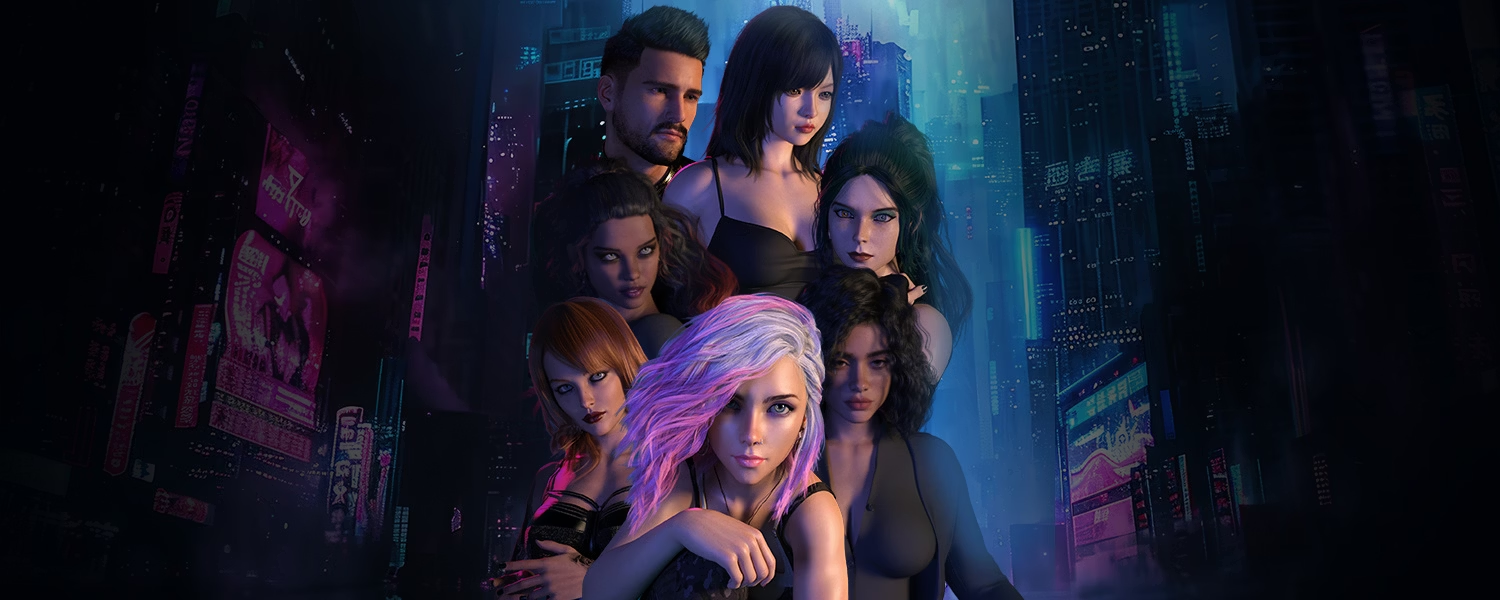
Version: Episode 2 - v0.02.11 Score: 6/10 Playtime: ~3 hours Reviewed on: 2025/11/29 Note: The game is in early development, so some inconsistencies in worldbuilding and narrative pacing might be ironed out in future updates. It's got potential in its cyberpunk themes but currently feels underdeveloped in key areas like character depth, worldbuilding, and its investigative narrative. Humor often misses the mark, coming across as forced or juvenile, especially through the partner character Jack. If you're not concerned with pacing, character arcs, or worldbuilding and just want to play for the renders and lewds... Then you'll love this game. General / TL;DR: The game explores a dystopian future with universal basic income, neural implants for instant knowledge, and an app that lets people rent out their bodies while their minds game or relax. It's an interesting setup, but worldbuilding inconsistencies, like unclear incentives for using Moonlight alongside UBI or anachronistic tech interfaces, undermine immersion. Choices for activities like gym sessions or hangouts add variety, but the buddy-cop dynamic with partner Jack quickly wears thin due to his over-the-top antagonism and unfunny quips. The largest issue with this game is how the writing conveys information. The player is constantly lagging in knowledge because the little exposition we get is often too vague or even dubious. Graphically, the game is outstanding. Animations have some issues, but their quality improves vastly over time. Gameplay: Moonlight plays like a standard visual novel with occasional choices that influence relationships and minor story branches. There are no complex mechanics beyond selecting dialogue options and the hidden renders in chapter 2. While some choices affect affection stats or unlock scenes, they often feel arbitrary or lack clear telegraphing. There is no gameplay involving the investigation itself, and the MC often discovers clues coincidentally instead of through his intelligence or deduction; other times they're handed to him by Akari, the precinct's genius hacker with yandere tendencies. Adult: Scenes are optional and tied to relationship paths, featuring encounters like gym hookups or intimate moments with LIs such as Akari or Max. They're avoidable without forcing progression, though some scenes feel rushed or gratuitous, like mixed-gender showers for titillation. Lewd actions are very vanilla with the customary handjobs and vaginal sex. Anal has been teased but not materialized yet. Akari's praise kink is sweet but is undermined by her yandere behavior. Ask yourself how much praise you can throw at a yandere before you risk getting stabbed. Visual: UI: Functional but anachronistic. The neural interface mimics a current-day cellphone, which clashes with the futuristic setting and feels uninspired. Transitions between renders take 0.1 seconds and are imperceptible. I recommend adjusting these to 0.3 seconds at the least if Ren'Py's default of 0.5 is too slow. The gallery only contains the collectible renders, not unlocked lewd scenes. Characters: Designs vary: appealing slim strippers vs. Max's tatted biker aesthetic (subjective; just not my preference). Most LIs follow the large ass/big tits archetype, some veering bimbo. Scenes/Renders: Renders are solid! Detailed environments like the Prometheus building and the karting track elevate this game. However, I also occasionally lamented the bokeh effect blurring interesting backgrounds. This developer has a great eye for detail. Akari's mom's name is written in Asian script on the virtual screen, and locations are filled with details and movement across renders. I have no complaints about the game's cinematography or character positioning either; they're great. There are a few hiccups that usually have to do with hair. Jack's hair occasionally increases in volume across renders (like when firing his gun), and Akari's bangs move forward when she opens her mouth. Animations: These are hit or miss. The penetrative scene with Max is just her model jumping forward without the MC pushing (standing doggy). The next animation showing Max in reverse cowgirl is much better, but the camera doesn't show the penetration. Akari's handjob shines with details (dick bending, facial expressions), but moving hot tub water would've been perfect. The scene with Umeko and Nora has the same issue with thrusting as the scene with Max. The MC's movement just doesn't match the reaction of Umeko's body. That said, the overall increase in quality is staggering. Akari's at-home scene is hot, especially her blowjob, but her doggy style scene just has her floating backward on the MC's cock. Novel: Synopsis: In 2046, Detective Alex McGregor (renamable MC) investigates the death of Moonlight's head developer, Cassie Morgan, amid a world of neural implants, corporate mergers, and anti-AI activism. We're slowly introduced to the MC's personal stakes involving his sister, Lilly, while leading the investigation into Cassie's death. Narrative: The story has a strong hook with conspiracies involving Prometheus, Aquila, and hacked implants, but pacing falters with badly timed exposition and luck-driven plot progression. Character arcs, like the MC's therapy sessions or relationships, show promise but feel underdeveloped. A prime example of this is his relationship with Max. The game starts with a flashback to 2043 where we're shown that Max and the MC are hooking up. When we get to 2046 and meet Jack, he tells the MC to "destress" because it's been a long time. That he perhaps should visit Max again. This lets us conclude that in the three years that have passed, the MC and Max haven't really gotten closer but likely have an FWB thing going on. After all, Jack wouldn't propose that the MC visit Max if they weren't on good terms and if she wouldn't help him destress. Except, when we meet Max, she states that they haven't spoken this much in years and that the MC being closed off about his struggles and emotions led to them breaking up... Later, in chapter 2, Max says that she left the MC instead of helping him through his grief, indicating that she left when Lilly got hurt a year ago. But then, why did she say they haven't spoken this much in years not two days ago? This kind of mismanaged exposition isn't only limited to Max, but also exposition about Lilly's coma and even about what drives the MC forward. And, sadly, it also applies to the game's worldbuilding as well. Quality of Writing: Technical: Superb. Minor US/UK spelling inconsistencies ("favour" vs. "favor"). Creative: Dialogue is hit-or-miss; some interactions, like with Charlie, feel natural and build slow-burn tension, while others rely on juvenile jokes or "because boobs" motivations that undercut depth. And some anachronisms (e.g., 2046 references to 20th-century media) break immersion. It's clear the developer loves movies and music, but there's a time and place for those references. For instance, Charlie references a song that was released in 1984, and we're expected to believe that the MC immediately catches this reference 62 years later. This would've been more believable if we were ever shown the MC consuming old media. Maybe he could tune in to the oldies station that's playing Taylor Swift? My largest frustration with the game's writing is that it doesn't pick a lane. It mixes buddy cop humor with absurdism, then switches to an over-the-top emotional scene with the MC bawling his eyes out over the comatose Lilly. The game's world, while fascinating, isn't really used for effect. And, for that matter, I don't get the impression that the dev thought things through with how this world would function or how technology would interact. Everyone having a neural implant would be nothing short of a complete paradigm shift. But what we're seeing isn't all that different from today's world. An example of this is the MC having a printout of Cassie's picture instead of using a photo-sharing app on his implant. The writer also isn't exploring that in a world where everyone can download the knowledge to do anything, like a karting competition, everyone downloading instant knowledge would mean physical ability/experience should dominate. Spoiler: From my notes - Regarding humor I'm seeing a lot of inspiration from the buddy-cop genre of movies. But the likeability isn't there. Jack is just unhinged and doesn't seem to take anything seriously. The narrative fails to make the audience sympathetic to him. Take Lethal Weapon. Riggs is unhinged and acts crazy, but we're shown he's fighting his own demons. We see his behavior through the eyes of his new partner, Murtaugh, who acts as an audience surrogate that explores what's wrong with Riggs. We have nothing like this between the MC and Jack because they've been partnered up for years. If you see their dialogue without context, you'd believe they don't respect or even hate each other. Instead, the audience has to assume that because they've been partners so long, they're also good friends. This is asking for a lot. We don't know Jack; we haven't experienced these years together and have to assume they get along great despite being shown the opposite. Big ask. The buddy cop genre follows certain tropes and unwritten rules: The serious/professional guy: Has to be competent and by-the-book. Can't be shown as weak or whiny Doesn't break under the unprofessional guy's pressure (hitting him), but gradually loosens up and rolls with it. The unprofessional guy: Has to be loyal and competent when it matters. (In RPG terms he'd be chaotic good.) His competence can't outshine that of the serious partner, unless the serious partner is in trouble, which is where his chaotic nature shines. Can't be malicious or truly incompetent Can fail upward (flawed execution is funny) His chaos must advance the plot. The audience needs to welcome his behavior because it leads to unexpected but positive outcomes. The scene with Jack driving the car undercuts this. We're told by Jack that he's taking the MC's condition seriously, which shows loyalty and competence. We could laugh at him driving like a maniac if he motivates it by wanting the MC examined ASAP. What we can't laugh at is him then showing a complete disregard for the MC by stopping for coffee and donuts, because this veers into the area of incompetence and disloyalty. He's no longer prioritizing his partner's health but his stomach. This absurd scene is an entirely different kind of humor, and it fails because absurdism doesn't require stakes or even ignores the stakes completely, whereas the buddy cop humor shines when the stakes are high, because that's where the conflict pays off. Jack constantly mocking the MC breaks another rule; it's not loyal, even less because the MC is hurt. The MC being the butt of every joke also undermines his straight-man role. Overall, it shows Jack as unreliable, not chaotically competent. I'm also noticing that Jack's antics are dialed to 11 whenever there's investigative work to be done. I don't know if this is a writer's crutch, but it happens every time. Instead of going over details and providing some exposition while discussing clues or observations, we just get Jack and his jokes/insults to pad the scene. Conclusion: Moonlight has a cool cyberpunk foundation with neural tech and murder mystery vibes that could evolve into something gripping, but right now it's bogged down by inconsistent worldbuilding, grating humor, and characters who need more baggage and growth to feel real. If you're into slow-burn LIs and avoidable lewd content, it might scratch that itch, but the investigative side needs more smarts and less coincidence to shine. Fingers crossed future updates tighten the screws! Spoiler: Suggestions: Dial Jack back a bit. He can be unprofessional, but he should always respect and support his partner. Loyalty is key. When shit hits the fan, the MC and the audience have to know they can rely on Jack. Presently, the odds are 50/50 that Jack will just point and laugh. Show that the MC is a competent detective who doesn't just luck into finding clues. He finds a card for Chat Room, a bar owned by his ex, and coincidentally has Zoe, who knew Cassie, performing there this evening. They look for cabs that visited the area because they wanted to see if Cassie used one. She didn't, but the cab's footage showed the mysterious man. Lucky break! Akari found the man at Moonlight's office. The shard with Cassie's not-an-AI is a gimmick. I love the Cyberpunk 2077 inspiration, but it again undercuts the MC's showing he can lead an investigation. Even Jack has better ideas than the MC, which undercuts the MC's role as the capable and professional straight man of the duo. What is it with women competing with the MC? Charlie makes the MC prove himself at the gym while just sitting there. Akari tires him out. It's great that Akari is capable. She's great at cooking, running, hacking, and receiving praise. But give the MC a win occasionally. He's too often the butt of the joke while not reacting to it. I'm not saying he should lash out, not at all! But there are various techniques used in comedy that work. The callback where the MC recalls an earlier insult and returns it. (Who is the idiot now?) One-up: Jack: "You're hopeless!" -> MC: "At least I don't cry during rom-coms." Deflection: Though to be fair, this is what the MC does: Jack: "Nice detective work, genius" -> MC: "Coming from Mr. Donut Emergency" Absurd agreement / sarcasm: Jack: "You're terrible at this!" -> MC: "Yeah, I solve cases by flipping coins" Role reversal: Jack: "You're so uptight!" -> MC: "Better than being a walking HR violation" Start the game with a sequence of sessions with Celeste. These would be short segments that have the MC tell his psychologist what's happening. As the sequences continue and time passes, the MC becomes less antagonistic toward her. First session right after the MC gets suspended for attacking the docker. Celeste challenges him, and he gets angry and yells at her about Lilly being hurt and in a coma, maybe never to wake up. This would also immediately explain what Dockers are, because this is currently very vague until chapter 2. Second session (could be a few sessions later) where the MC tells Celeste about breaking up with Max. Celeste decides that he's fit to resume duty. She could motivate this by wanting the MC to keep busy while also believing he poses no acute threat to anyone. Last session, a week before the session in Chapter 2 where the MC tells Celeste about his current state of mind. She could ask him about being over Max and if he's looking for intimacy or a human connection. This would inform the player how the MC treats intimacy. Is he looking for something that lasts, or just to get his dick wet? The game could use this session to inform the player that this isn't a typical harem game. After this session we have Jack pick him up, and we get the conversation in the car. When we go to examine Cassie, the car conversation gets skipped instead. Something like this would adequately set the baseline for players and inform them about what happened in the three years between the prologue flashback and today. There's a severe lack of police procedure with detectives just roaming around an office building and requesting access to computers with company secrets without batting an eye. Instead of a plot hole, this can be turned into a strength by changing what being a detective means. Some inspiration from Judge Dredd (but without the wanton killing) would work. Detectives in this future could require the same clearance and training as US marshals do today. The NI could motivate this change, where detectives would constantly record their activities. This, in turn, would grant detectives certain extrajudicial rights and considerations, and a certain leeway concerning fruits of the poisoned tree. Maybe still a bit of a stretch, but much less of one than them roaming around the offices of the largest employer of the nation and not immediately getting escorted to the legal department. Or Jack potentially contaminating a crime scene when taking food out of Cassie's fridge.