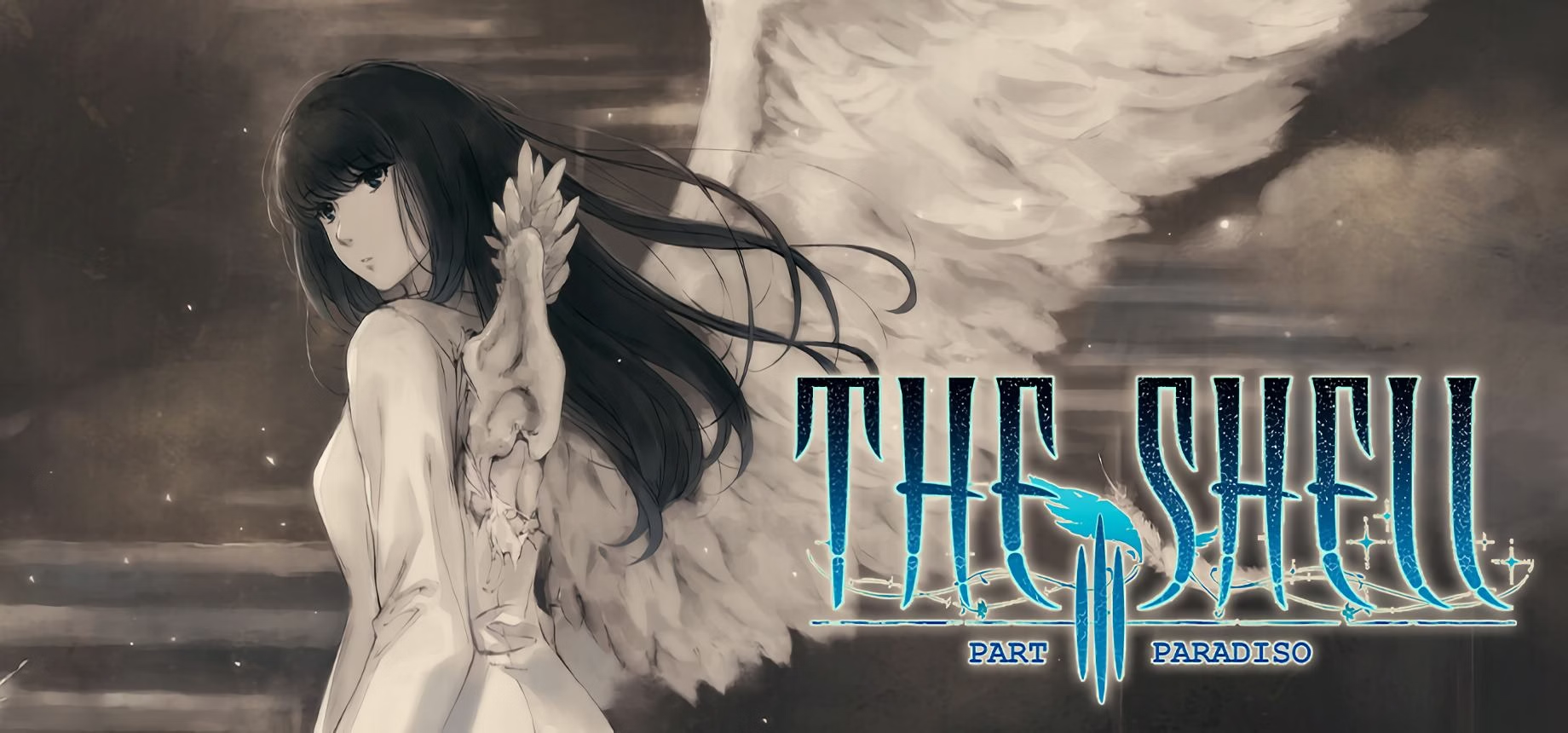
The Shell Part III: Paradiso

by Innocent Grey

Uncensored Windows
Versionv1.0.0H + IP
EngineOthers
Released2025-02-21
Updated2026-04-09
LanguageEnglish, Chinese

The coiling chains of obsession that began with The Shell now threaten to strangle Detective Reiji Tokisaka in the third and final entry in the trilogy. As old friends and foes rise up for one last confrontation, can anyone break the cycle—and can Reiji's heart ever be set free?​

bruhman800 2025-02-23
This was a fantastic way to end this trilogy. i came into this with low expectations since i've seen a lot of people call this bad but man.... i've never cried while having a big goofy smile on my face in my life like i did when i unlocked the true ending. I would prefer to avoid spoilers so if you've read the first 2 Kara no Shoujo VN's this is 100% worth it.
forthewins 2025-02-16
This is probably the most mature storytelling I've ever seen in a visual novel. It isn't as long or as complicated of a story as the 2nd game in the series was, but it really felt like the absolute perfect ending to the series, and to drag it out any further wouldn't have made much sense. The few "sex scenes" that are in the game are nothing you wouldn't see in a typical R-rated movie. The camera remains above the waist, and they're all 100% relevant to the plot. So if that's what you come to this looking for you're bound to be disappointed. But if you're looking for a great story, this series is as good as it gets, and this is pretty much the perfect conclusion to it, IMO.
InsaneMonster 2025-01-26
Thought I'd write my first review here as a sendoff for a trilogy that is my obsession, no pun intended. I'll put up a spoiler for the review section as there are too much words for those who's only interested to know if the VN is good or not. Also, translated walkthrough and save bundle here . I do not take credits for this; it belonged to Seiya-Saiga. Overview: The game has 15 endings technically, although one is not counted in the official ending list. This makes for a lengthy VN, which is sort of a rare breed in the 2020s with how "VN blizzard" loomed across eroge studios for quite some time now. There is enough content, further extended with the need of multiple playthroughs if you are going for the complete experience. From a VN / game standpoint Paradiso leans closer to the former, meaning that the gameplay is not going to be the focal point of the product, and so if you are interested with immersive detective sleuthing games this is not going to scratch your itch as its mostly about clicking objects on a 2D image during investigations much like a find-the-difference puzzle, or the more common "pick your evidence/suspect" deduction phase style, then repeat these multiple times in one playthrough, repeated again through multiple playthroughs. I am no artistic connoisseur to review the art style of Paradiso. Sugina Miki is a relatively well known artist in the industry by now. I would simply say the artwork itself is very well made, more so when the context of the story is considered, but might not impress if your preferences are computer enhanced 2D/live 2D/3D images, or AI based. Specifically for Paradiso, some of the character models might also come across as monotonous despite how the story was meant to be told. That said, unlike the previous 2 works, Paradiso has very softcore sexual content. Even from a horror/violence perspective, the depictions are significantly less graphic than its predecessors. Instead, the acts are enhanced with audios, which isn't much in today's standards. The lack of scenes in the gallery also suggested a shift in focus of the game, and might not sit well with new readers who's expecting them in a standard eroge. Just like Sugina's gamemaking philosphy, Paradiso is made to satisfy a certain niche, and the art and game direction for this product made it clear that its not meant to serve as the common gory erotic VN in the market these days. The VN might come across as average, or downright unimpressive if you have not previously experienced the prequel works, specifically Inferno and Purgatorio. To close, Paradiso did what it has to do - it is the final sequel of a trilogy, made to provide closure to fans that expected a conclusion of the characters that they've known and loved over the course of two works and several arcs. To do that, Innocent Grey has released this 8 years since Purgatorio, and there are some noticeable new elements in this product compared to the prequels while maintaining a standard of high quality music and artistic expression, important traits of a good VN. For the fans Paradiso might score higher than what is rated here, but the work is not without its problems from an objective point of view, hence a 4 star on this platform is what I would rate as a fair score in general. Spoiler: Worthless Paradiso Story/Character and Overall Trilogy Review with Spoilers [Wall of Text, like seriously, Great Wall of Text Built with Almost 3000 Bricks] This is the second time I've gone through Paradiso, first time through the unofficial Mandarin translated version (manual translation by 2 Japanese gurus). The English translation came to me as sort of wild if the figurative/literal meaning of the original Japanese language is to be considered, and the official Chinese translation also felt a bit weird when it comes to language use. That being said, the overall message is still communicated and the translation is not as bad as some might lead you to believe. I would use serviceable to decent as a rating measurement for the overall translation quality. With Paradiso, my overall feelings have been mixed, with a tinge of frustration in between, but that is mostly due to the structure of the trilogy as a whole. As mentioned, Paradiso achieved what its meant to do: it has 2 major endings, both bittersweet and melancholic in their own sense, and most importantly, made sense. Not perfect, but feasible to accept as a conclusion. It also invoked emotions especially the true ending, knowing how Iroha Saegusa (or Ruri Tokisaka for that matter) finally reunited with her father through a fateful bond carried by a bluebird (which is in fact, the resemblance of Toko's hopes and love in her brief life) at the same park where the trilogy first started serving as the response to the prologue words in Purgatorio. It was a celebration of the spirit of Toko Kuchiki in the form of Aoi Tori , a surrounding theme of the trilogy. Innocent Grey certainly placed a lot of emphasis in this as well, from the naming of Ruri meaning lapis lazuli, to the true ending's theme song named as Ruri - Aoi Tori. Thinking back, the only next time where I've experienced similar resonance to an ending of a work would be Higehiro, albeit not to the degree of Paradiso. There are tears of happiness for Reiji, Toko, Iroha, Kyoko, Uozumi, Fuyumi, and both Yukikos (Miyama and Kayahara) in general. That said, once the dust settled and I've started to review and process my overall feelings to Paradiso that disappointment came, and unfortunately there are more characters that would fall here, and much of the overall story. It is not hard to notice that Makoto Rokushiki is the ultimate villain of the trilogy, but his involvement in this supposedly final episode of a series of serial murders that he orchestrated and influenced throughout not only felt superficial with a short arc involving the Yaginumas and Kuchikis, but downright disappointing with his little arrest arc and whatnot. Its almost as if Innocent Grey suddenly realized their major antagonist has up to this point in the VN, not involved in the first serial murder in any meaningful degree, and there are remaining loose ends with Eriko Yaginuma, so they are put together and served as interludes of the major arcs here, with some strengthening of the part stories using Kaede Watanuki. While this is not an invalid way of telling a story, it certainly is a poor way to do it, as not only the stories have very little supporting substance but the execution overall gave a pretty cheap vibe to it; almost as if the new characters involved in the serial murder arc were created not to tell a new immersive story, but solely to provide a body to support the real story arc of the VN - Iroha's abduction, again a recurring criminal theme across the series (Toko = abduction). It created several problems, notably the lack of development of the new characters which deviated heavily from the previous two works, and a very rushed and predictable plot which defeated the purpose of a forensic novel. You can almost feel that Chie Kuboi will either die or kill somebody due to her relationship pattern with Yukari Tokisaka, and characters whom have killed or died in similar patterns have been given more personality and development than Chie here. Overall, Makoto deserved a much better, glamorous ending even, after what has been done, and how the stories have progressed. Being shot dead by Reiji as a form of harm prevention measure is not only contradicting to the changes Reiji exhibited during the grand ending (maybe Innocent Grey's explanation here is Reiji has transferred his obsession of both Yukiko and Toko to Iroha, thus he made the decision to pull the trigger unlike the event in Inferno), but made for a joke for the true ending where Makoto's death by execution is done so humbly. The sort of "I've made my peace" ending with him also really don't sit well with me, as its obvious that in both endings his obsession in delivering his twisted justice is never going to be sated because Chizuru is still alive and well. Given how Fumiya is being set as obsessed with Toko, the possessiveness and past of Chizuru one might even say that an ending where Chizuru is murdered by Makoto, and a manipulated Fumiya assisting Makoto in another murder spree that involved Eriko might have been a much stronger plot. I've resigned to myself at one point that maybe if Makoto's chapter with Yaginuma was shifted earlier as an event after Toko's funeral, resulting in the Kuchikis' manipulation by him, then a timestamp that allowed a chance contact between Chie/Sae with a hiding Makoto, resulting in their manipulation as well which culminated in the serial murders then it would be something I can subscribe to, but who am I to judge really. The new killers in this VN were also uninteresting because of the issue with predictable story telling in the angel murders. Like Yukari, Masaki was also a relatively strong murderer magnet so she also very quickly became one of the primary suspects of the murders alongside Chie due to the very little initial background that's being added to their personalities, and Sae being the serial killer became evident once its established that Chie murdered Sasakura after the earlier event and the different modus operandi. The use of a faked death trope was reasonable as this was a period in Japan where criminal/forensic investigation techniques were still relatively underdeveloped. Ultimately, both Sae and Chie felt like characters that existed because killers were needed to complete the arc, and in return got off the hook at a much lighter ending. Admittedly the second arc was also poor in execution, but not entirely unreasonable in that abduction was the main theme with the disappearances and the murders only served as a recurring motive to involve Reiji as a homicide detective in those cases thus providing a setup for the father-daughter encounter. Quite frankly this arc has so much potential, but ultimately sank because of the poor execution of both Makoto's interlude and the angel murders. It sort of dawned to me after the Heavens ending that the development of Paradiso might have been done in a linear fashion where one arc started development only after another is completed to reduce errors in linking the prequels together. The abduction arc was really the closing arc for Purgatorio, and the serial murder arc was to close out Inferno. By following this train of logic the character appearances and their development in Paradiso immediately made more sense; Kyoko's triangle only surfaced in this arc because Kyoko has an extensive involvement to the trilogy in Purgatorio, while Masaki needs to be involved here because the arc will close out Naori and pretty much Masaki's chapter overall. But because of the fast forward timestamp to satisfy requirements of Iroha's growth to a child with some degree of autonomy in memory as well as Sato's growth as a police officer fresh out of training, the same time extension has to be given to all the remaining characters resulting to awkward developments for Maris Stella, Reiji, Masaki, Yukari and even Yaginuma in general. Whenever I had a chance to think back on this hole I'd always think that if there was a suitable interlude to be placed between the arc to replace Rokushiki's murder I would expand the relationship dynamic play between Kyoko, Stella and Reiji leading to Kyoko ending her relationship with Reiji, followed by the development of Stella/Reiji and Kyoko/Uozumi, at the same time prepping Masaki/Yukari. Innocent Grey attempted to do all these through alternative views or insertion in between key plots in the arc, which felt lightweight and lacked lasting impact while needlessly increased playthrough times. Naori on the other hand has to be scrutinized through the lens of Manami as it might not be clear in the beginning, but Innocent Grey seemed to want to tell his story through the sick little girl regarding a person's conscience which made Naori a worse killer as one killed with a voluntary conscience while the other killed because there was no conscience from the get go. Which led to the endings. Because of the way the arcs were executed in Paradiso both endings felt like the most acceptable endings as they were probably the only few reasonable endings left in the tank to justify Paradiso's existence. But if there is anything to be said about all these, the way Innocent Grey suggestively hinted at the closure of some of the involved characters gave room to plenty of ambiguous and open ended possibilities, and this indirectly became a blessing in disguise for the novel. I personally found that even for the grand ending which is probably the more definitive ending between the two when it comes to all the characters involved, the definiteness of some of the characters felt forced and contradicting to all the buildup of their character personalities at this point. The most glaring of them all being Maris Stella, where the only tangible advancement in terms of Reiji's plotline being the discovery of Toko's remain and the moving out of Yukari after her graduation suddenly providing a space for Stella to be Kyoko / Toko replacement and provide her only soft sex scene in the trilogy. Its so awkward in both the timing and the context of Stella's background that one really wondered if the accumulation of so many context in both Inferno and Purgatorio just went poof because Reiji needed to have his needs sated for the sake of mutualism, as if Kyoko never served that role in the past 2 works. Secretly there is another part of me that wished for Miya and Miki to be ruthless enough to take the really tragic route and kill off overlapping major characters to strengthen bonds of the remaining living characters and round up their stories better, a tragedy involving Yukari or Uozomi for example, especially with Naori's cold-blooded conscience. In contrast, the true ending which only focused on Reiji, Toko and Iroha was probably the ending that justified Paradiso after all, and the ending the trilogy deserved. The whole ending was short but satisfying with each sentence actually carrying meaning behind it, I honestly would say the few minutes of that ending alone would have justified rereading the whole trilogy in terms of the canon story-lines, as it is the epitome of a truly excellent journey of a love story bound by tragedy and hardship. It also provided ample open ends to the remaining characters for readers' imagination, but in truth what really mattered was the Reiji/Toko line after all was said and done. Which left Reiji and Masaki. There were rather little to say about both of them in Paradiso because they developed mostly as reasonable responses to the crimes around them, and the deductions were simplistic enough there weren't too many ridiculous outliers along the way. Which made for a pretty bland ending pool especially for Masaki because the authors pretty much severed every other possible ending branch leading up to the available endings, ie. Kyoko and Fuyumi. They may not be canon endings, but certainly would provide more substance to the novel. Ultimately both ended up alright, maybe Masaki deserved a bit more but they more or less ended up fairly close to where I'd expect them to be. When I shed tears for Inferno, it was shed for the tragedy of Misa and Toko; when I shed tears for Purgatorio, it was shed for the tragedy of Reiji and Toko; and when I shed tears for Paradiso, it was shed for the reunion of Reiji and his beloved ones. But after the roller coaster ride, there will always be the lingering question that is whether Paradiso should exist as it is, or whether it should have been released as a shorter After Story version instead. In the end I've reached a conclusion that Paradiso delivered as an adequate closing sequel for both Inferno and Purgatorio, but is certainly not the high flying quality VN that can hold its own given the stretch and plot holes with several weak stories and questionable interludes. Then again, after stripping off the alternative endings of the trilogy and forming the canon story-line into a linear playthrough, each VN had played their part in the trilogy well, and thus in an overall sense can be judged as very high quality work indeed. Because in the end, despite the massive character pool and how each character reacted with each other, the journey of how Reiji found Toko's true self, and indirectly his own true self is what mattered the most. I could go on with the ramblings of the remaining characters of the story, about how the Masaki/Yukari partnership really needed more to be considered as polished or needed to happen at all, the unrequited feelings of Yuu a really nice touch in representing the fate of the friends in Hitogata and their separate endings (thus Purgatorio overall), the potential of a complete Masaki/Michiru reunion, Yukiko's state of mind, even the Girl in Eden which felt rather lame the way the VN presented the short story. But ultimately, it is time to also let go of my obsession that is Kara, Uro and Ama no Shoujo, and bid farewell to a VN series that played a not small part in my life especially during the pandemic.

You might also like